

Omnia Swedan and the sanctity of the forbidden
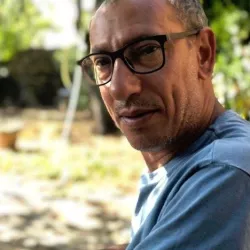
Chance, or circumstance, grants some people the opportunity to receive a decent education, either because of their intellectual aptitude and inclinations or because their families are financially comfortable. Good fortune steers them toward fields, such as medicine, dentistry, and pharmacy, that usually promise a stable life, substantial income, and social standing.
Some of these people, who carry a restlessness that cannot be stilled, abandon their distinguished professions to try their luck in the arts. As someone who teaches cinema, I have met and taught a number of them. I used to tease them, affectionately, calling them broke and reckless: they had passed through what our families call “the top faculties,” only to leave those professions behind for cinema—a field where success and financial security belong to a small minority, and rarely the most talented, especially if their chosen path is documentary filmmaking.
Jokes aside, most of these people fall into one of two categories. The first studied what they did not love, carrying an artistic obsession that needed an outlet, and deciding to test it in the hope it might be realized. The second are restless souls who watch the moral and political decay, the economic and social collapse, around them and cannot adapt or make peace with it. They choose, instead, to narrate the wreckage and lay it bare, and they look to cinema as a means to do this.
I do not personally know Omnia Swedan, the physician who wrote the testimony exposing medical malpractice at El-Shatby University Hospital. But from following her Facebook account in recent years, from what has been published about her after her testimony and the furor it unleashed, and from reading the testimony closely, she seems to me to belong to both groups — those inhabited by an artistic impulse they want to test, and who cannot make peace with the wreckage.
Her ill fortune in these times, however, has made her a double victim. On one side, arrest, interrogation, and referral to trial; on the other, a smear campaign branding her as a mentally disturbed woman who tried to attract attention to her page by spreading lies.
The no man’s land of public discourse
Before Omnia Swedan’s testimony, social media had been consumed by another case, that of lawyer Nessma AlKhatib, who argued that sex workers deserve access to healthcare. She was subjected to a smear campaign, her words were distorted, and the Lawyers Syndicate opened an investigation against her, suspending her from practicing law until the inquiry concluded.
Nessma’s case ran the inverse course of Omnia’s. Society put the lawyer on trial first, in the court of public opinion. Then the one body that should have defended her right to speak—the Lawyers Syndicate—punished her on the basis of that public verdict.
By contrast, in Omnia’s case, a portion of public opinion embraced her testimony, and this inspired others, men and women alike, to speak out. It was the state that punished her—with detention, investigation, referral to trial and, most importantly, defamation and character assassination—exploiting the fact that she had spoken about a subject everyone avoids, even the victims themselves. In this case, the state presents itself as the “wise and conservative guardian” of its citizens.
Omnia’s testimony deserves serious, multilayered critical discussion, not punishment. One layer is the role Egypt’s political system, since the era of Sadat’s open-door (infitah) economic policy, has played in dismantling the public healthcare sector that Egyptians built with their sweat, money, and sacrifice. Public healthcare, alongside other sectors like public education and production, has been razed to the ground to clear the ground for Egyptian and foreign private investment.
Decades of deterioration have brought us to a reality in which only the wealthy receive “relatively acceptable” treatment, and only in private hospitals—much as only their children receive a decent education in foreign and international schools. This reality has been produced by a political system whose class-based economic and social choices are deeply hostile to the poor, and at whose core Egyptians’ health—or, in the case of the El-Shatby Hospital, Egyptian women’s reproductive health—is simply of no concern.
This is one of the dimensions absent from Omnia’s testimony. The accusation must be directed squarely at the political system, rather than at the nameless individuals she describes. That system is the main actor responsible for where we have ended up; for gutting working conditions in healthcare, education, and beyond, to the point that individuals are pushed toward these practices, toward exploiting and suppressing one another for sheer individual survival, and toward exercising violence whenever the opportunity arises.
Some of the medical staff Omnia describes in her testimony may themselves be victims of this system, not just the women who went to the hospital to give birth or to have abortions. This, too, must be discussed, so that the testimony is not reduced to a story about individual acts of wicked men and women. We are speaking of a patriarchal system that oppresses everyone, but women, especially mothers, are the most vulnerable in this chain of oppression.
None of what is describes is merely individual behavior; it is the product of an ideological system that turns into violence on mothers’ bodies and that perpetuates class contempt for the poor.
The stigma of mental illness
In a normal society and in normal times, the expected response from the Health Ministry or Alexandria University would be to summon Omnia and investigate her testimony. If confirmed, they would open an inquiry into any violations or crimes, ensuring accountability for the perpetrators. The authorities and society would then work togerher to prevent such incidents from happening again.
Instead, Omnia was immediately arrested, interrogated, and referred to trial. A coordinated smear campaign was launched against her, with the participation of websites and newspapers acting on orders from sources we may or may not know. She was portrayed as a liar and as mentally ill.
All this is proof enough that we do not live in normal times or in a normal place, especially given the complete absence of any official statement attributed to the prosecution. What remains is the systematic defamation of a woman on the pretext that she stopped practicing medicine because she “abuses” psychiatric medication. No one asked why she left the profession, even though some of the reasons were laid bare in her own testimony.
According to figures from Egypt’s Health Ministry released a few years ago, a quarter of Egyptians suffer from mental disorders. Many citizens can be seen talking to themselves on the streets, burdened by depression that often goes unreported due to their living conditions. How, then, does mental illness become an instrument of shaming, defamation, and condemnation, rather than a reason for compassion and care?
The attempt to discredit someone for describing their hospital experience is different to discrediting those who share prison experiences. Few Egyptians have been imprisoned, making it easier for many to doubt those accounts. Healthcare is different: it is something everyone has lived through, in some form, No one can credibly claim ignorance of the general picture.
We all know the tragic stories surrounding this great wreckage. Yet, a young physician is denied the chance to rebuild her life after speaking out on Facebook. Instead of support, she faced her downfall for telling her truth. The message from the state is clear: engage in art if you must, but do not speak of your experiences. If you do, there will be no mercy, no forgiveness, and you will never practice medicine again.
Had Nessma AlKhatib and Omnia Swedan not been women—had a male lawyer voiced the same opinion on healthcare for sex workers, or a male doctor given the testimony about the El-Shatby Hospital—would the societal and authoritarian reaction in both cases have been any different?
That question does not need an answer. It is enough to recall that both incidents coincided with the head of the Sohag Lawyers Syndicate suspending lawyer Lu’a Khalaf Bakri Othman from practicing law “provisionally”, pending an investigation into the clothes she wears in her social media posts.
Published opinions reflect the views of its authors, not necessarily those of Al Manassa.