
Outside prison, inside the sketch: A day Ashraf Omar escaped the ‘vicious cycle’
Two years behind bars, an endless grind for the cartoonist
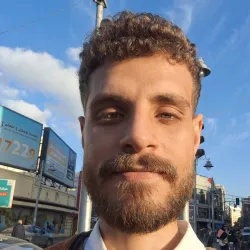
“It’s a vicious cycle where we have zero say in anything.” Nada Mogheeth sounded dejected as she recalled the latest in the case of her husband, cartoonist and our colleague Ashraf Omar, speaking at a solidarity gathering organized by Al Manassa on Sunday, July 19, to mark two years since his arrest.
But Nada quickly regained her composure, her face softening into its usual warmth, and spoke with conviction that this closed circle could only be broken by holding fast to hope: “We’re going to stay steadfast…first because we have no choice, and second because if they decide to kill us, we’ll die standing.”
That pull between heavy despair and a small measure of hope wasn’t Nada’s alone; it was the prevailing mood as Ashraf marked two full, whole years hidden away behind prison walls. Everyone who spoke or sent a message paired their disappointment with a desperate reach for hope.
Nobody—least of all those who came last year for Ashraf Omar’s birthday—imagined they would be back for a second year without the guest of honor.
“It never crossed my mind that a whole year would pass and we’d be holding this event again,” said Nora Younis, Al Manassa‘s editor-in-chief, opening the evening. “We are living a nightmare that has to end.”
She welcomed the room with words that carried both warmth and weight. “We’re glad to see you all here—glad for the momentum that’s built around freedom of expression these past two years, glad for the solidarity you’ve shown. But we are deeply grieved that these are the circumstances that bring us together.”
Then she handed the floor to the evening's host, our colleague Amr Gad.
This endless grind
The “nightmare that needs to be broken” in Nora’s opening was the very same “vicious cycle” Nada had described, where staying steadfast was the only way out.
Nada didn’t address Ashraf’s family. She didn’t turn to the journalists, the human rights advocates, or the artists gathered in the crowd. She didn’t speak of her husband’s drawings, hung around the perimeter of Al Manassa’s garden alongside cartoons sent from Egypt and around the world. Instead, she placed the jailer squarely in front of her—addressing him, again and again, as if he were standing there to hear it. She was trying, she said, “to tell them there’s no need for any of this. It makes no sense.”
Even as the Chinese language professor held onto her usual reassuring cadence, she couldn’t hide the grief and exhaustion etched into her face—nor the toll of what she called “this endless grind we’re all in.” Her own energy, she admitted, had run out completely. But when Nora Younis called to propose the event, something in her answered anyway. “To be honest, my energy was completely gone,” she said. “It was like, ‘Okay, if you have the energy, let’s do it.’ So thank you, truly, for the energy and the spirit everyone at Al Manassa has.”
Speaking for the wives and mothers of thousands of political prisoners in Egypt, Nada summed up what prison had stolen from her life: “Two years have passed—four Eids, two Ramadans, two New Year’s Eves. New Year’s is a big deal for us, when we look back at what we did over the year and make new plans and dreams. I missed that with him… He missed four major surgeries for people close to us, including me. And he missed so many funerals for key people, most of all his uncle. He suffered deeply over that.”
Ashraf’s absence began at dawn on July 22, 2024, when plainclothes security forces raided his home in Hadayek October, carrying him off handcuffed and blindfolded to an undisclosed location. After two days of enforced disappearance, he surfaced before the Supreme State Security Prosecution, which interrogated him on charges including joining and funding a terrorist organization, spreading false news, and using a website to promote its ideas.
The prosecution questioned Ashraf about unpublished draft cartoons, asking whether they were his own ideas or dictated to him, and whether he intended to overthrow the regime. He denied all charges, stressing that his drawings were journalistic works published for Al Manassa. After 16 months in pretrial detention, he was referred to trial in November 2025. The first session took place in May before being postponed twice—most recently to October 12 to question the investigating officer.
The absurdity of it all
Two years spent shuttling between prosecution offices, courtrooms, and prison visits shattered what Nada Mogheeth called “the innocence of the beginnings”—back when she thought explaining the absurdity of the charges or appealing to the law and mercy might bring a quick end to the ordeal: “You realize that words of mercy or pleading mean nothing,” and that we are stuck in “a vicious cycle where we have zero say in anything.”
“I’m not just unable to feel safe or believe in justice—I don’t even know how to be pragmatic and pretend I believe anymore.” This was the peak of Nada’s despair and sense of the absurd as she recalled the indignities of daily life: from being forced to pay for a bus ticket inside the prison just to reach her husband’s visit, to being personally interrogated on terrorism charges after giving an interview about his arrest. Still, she closed by reassuring the room about Ashraf: “I want to reassure you that Ashraf is doing well, and we’re going to stay steadfast…”
Steadfastness isn’t the only way to break a siege; the trial itself can become a source of inspiration. That was what cartoonist and poet Saad Eddin Shehata wanted to remind Nada, urging her to push past the despair. He opened with a line from Alfred de Musset: “Nothing makes us great than a noble grief.”
“The prison experience will add to Ashraf… to his life and his art.” Shehata invoked Mikis Theodorakis and his immortal score for “Zorba the Greek”, written behind bars. He cited Francisco Goya, imprisoned for painting the royal family with the marks of age on their faces; a year in prison left Goya so furious that he poured it into work “akin to political caricature—full of extreme distortion and a fierce sense of refusal.”
The same words, the same circle
“The vicious cycle” returned once more in the speech of Journalists Syndicate board member Mahmoud Kamel. This time, it doesn’t just enclose us—we are its fuel, spinning inside it as it spins around us, with no exit and no rest. Greeting the crowd, Kamel apologized for having nothing new to say, because the words simply repeat themselves: “I’ve been on the syndicate board for 11 years, repeating the same words. We have been spinning our wheels.”
Kamel pointed out that among the more than 19 journalists currently imprisoned alongside other political detainees, Ashraf Omar remains “the only cartoonist behind bars.”
For the syndicate official, Ashraf’s imprisonment reflects how the authorities view any voice that reaches the public square: “They think they’re keeping the cartoon from reaching the citizen who can’t read, blocking the ideas of the artist, the writer, or even the ordinary person locked up for a post. Ashraf speaks for all of them.”
The tragedy doesn’t end with detention. Mahmoud spoke of the syndicate’s struggle and its being barred from visiting or checking on imprisoned members: “I remember the last time I visited an imprisoned journalist on behalf of the syndicate was Hesham Fouad and Hossam Moanes—that was over six years ago. To this day, through successive board terms and syndicate presidents, with people constantly going in and coming out of jail, we’re stuck at the exact same spot. We aren’t even allowed to visit them.”
“Let them amuse themselves”
Journalists Syndicate President Khaled Elbalshy renewed the demand for the release of Ashraf and all prisoners of conscience, calling an end to this file the only true starting point for any talk about the future: “I want everyone to be able to say their piece, to express themselves without being hounded, without facing the fate of being torn from their families for months.”
The syndicate president found himself forced back to basic first principles, stating the obvious as if the authorities still don’t grasp that defending someone’s right to speak doesn’t mean agreeing with them: “It’s my right to defend anyone, and it’s anyone’s right to speak out, even if they’re my opponent.” He urged closing the chapter on political detentions so society could turn to other battles: “I don’t want to be consumed with people locked up for an opinion; I want to be consumed with someone struggling to draw a better future or feed their kids.”
Elbalshy spoke of the quiet suffering inside homes, noting that prisoners aren’t the only ones paying the price; the punishment extends to families from one visit to the next, until “instead of you supporting him, he’s the one supporting you, giving you strength—the whole dynamic gets flipped upside down.”
The syndicate president ended with a message to whom it may concern, heavily laced with irony and a callback to Hosni Mubarak’s famous dismissal of the opposition: “Let them amuse themselves.”
“You know everything. I know you do, but maybe a stray message might set things right… maybe someone out there, somewhere, also knows everything,” Elbalshy said addressing the regime. “you might be missing a small piece in the corner where I’m standing. Let me be your eyes, let me be the one carrying the message to you, let me be the bell that moves you to a different space, or even let me be a passing word that doesn’t matter—let us amuse ourselves! Maybe one day the message will be different.”
Scared? Just look at the sketch
“A drawing that doesn’t know how to play smart or flatter / Naji’s flaw was that he lived honest / He lived for the drawing.” Abdel Rahman Al-Abnoudy’s elegy for Naji Al-Ali comes back to me as I wander through Al-Manassa’s garden, stopping before the pieces in the parallel caricature exhibition. Renders and sketches surround us on all sides, four of Ashraf’s standing out in particular—his most famous, fiercest, and most biting critiques of government policy.
Caricature is the tip of the spear; that is how the old masters of journalism always treated it, giving it pride of place. When you cannot say the word outright, leave it to the drawing. The laughter wrapping the artwork, the sharp satirical lines, the comedy and lightness cushion the blow of a fierce message directed at a fragile regime, allowing what needs to be said to break through without heavy losses, letting journalism do its job.
No one imagined a day would come when caricature could be tamed—when newspapers would fill with lifeless drawings praising state policies or celebrating the men who make them. The art form is wild by nature. Ashraf drew boldly, carrying forward the legacy of Egypt's founding cartoonists. Our colleague, Al Manassa cartoonist Makhlouf, said his jailed friend inspired other artists to abandon “the safe drawing.”
Ashraf chose the drawing that disturbs authority instead. That path, Makhlouf insisted, “is far more inspiring—an artist who gives up the simple or safe drawing and chooses the one that might put him in danger, or the fierce drawing that troubles a regime or a person. I think any good cartoonist, any artist who loves their craft, would choose that drawing.”
Because caricature is an elusive art that defies prediction, it made its presence felt at the event in its own way. Refusing to let one of its own remain confined to a cell, it sent two of its sons—Makhlouf and Mostafa Salem—to break the circle, if only for a few hours, and carry him back into the realm of drawing.
The two artists set up at a table in the corner, sketching the faces of everyone present—friends, colleagues, and strangers who had come to show support. Each artist drew a portrait of every attendee, one after another, right beside Ashraf's face—a quiet statement that he is not alone in his trial, and that the circle might break if the number of faces becomes too large to contain.
At that same table, pens and stationary were set out for anyone wanting to write a note of support for Nada to take on her next visit. Nora Younis teased the crowd, reminding them that "the letters get read [by the jailer]… but we’ll hand them to Nada so she can try to deliver them."
Gen Z completes the picture
We are still in the garden. Our colleagues Victor and Gasser El Dabea wander around with a camera crew, circulating among the guests to record video messages wishing Ashraf freedom and strength.
Gasser, Victor, Montaser, Sara, Tamara, Lama, Marwan, Eid, and Enas—journalists and writers from Gen Z—were all there, some covering the event, others showing support. They saw in Ashraf and his case an expression of their generation’s modest attempts to live, speak out, and experiment in the face of policies designed to silence society.
Mohamed Montaser gave a speech saying the point of repression is to make people lose their voice. Yet he insisted Ashraf would return, and that the coming days “will bring shame on whoever caused any pain” to him and his family.
The speeches were as varied as the crowd—lawyers, rights activists, journalists, writers, and intellectuals, including rights advocate Azza Soliman, lawyer Mahienour El-Massry, Ashraf’s sister Dina Omar, activist May Mehdi, lawyer Mohamed El-Baqer, lawyer and activist Haitham Mohamedein, activist Tareq Shalaby, and journalists Youssef Shaaban, Bisan Kassab, Mahmoud Hashem, and Mostafa Mohie.
Academic Kamal Mogheeth, Nada’s father, described Ashraf’s case as reflecting an “abnormal” state of affairs where institutions and rules are absent, and the country is run by security decrees—turning into a “black hole” capable of swallowing anyone who objects or speaks up, starting with Ashraf and other prisoners of opinion.
Writer Ammar Ali Hassan wished the gathering had been dedicated to celebrating Ashraf’s work rather than standing in solidarity with his confinement: “We wished today could have been a celebration of Ashraf Omar, where we brought in specialists in his output; someone to speak about his translation work, which is extensive, another to discuss his passion for music, which seems deep-rooted, and a third to tell us where to place him among contemporary cartoonists.”
Ammar lamented what things have come to: “We are living in extraordinary times, an oppressive era, a dark epoch saturated with tyranny… We used to read about it in books, but it seems what we read about past decades in the memoirs of those who passed through prisons and left this world after suffering under political life—it seems that was a walk in the park compared to what we’re seeing today.”
From a legal standpoint, lawyer Wafaa El-Massry emphasized that the constitution guarantees freedom of expression and prohibits imprisonment for publishing offenses except in specific cases. Meanwhile, pretrial detention is weaponized today based on police reports that routinely lack evidence. She called on court presidents to use their authority to inspect detention centers and review the status of pretrial detainees, especially those who have exceeded the legal limit.
“We aren’t asking for much; we’re asking for reason, sanity, and the enforcement of the law.” Wafaa El-Massry closed her speech with that sentence, capturing everything the attendees were asking for.
“For the law to be enforced. For reason to govern. For sanity to prevail.” Only then will the closed loop break; a loop that risks exploding in everyone’s face, with no one able to predict when or how hard it will detonate.
This is what Ashraf’s drawings warn us against, calling on us to pay attention to the unbearable pressure; to lift the heavy burdens off the back of an exhausted citizen who is flogged by a soldier to pull the monorail: the “national project” that swallowed billions of Egyptian pounds while our economy collapsed.
At the end of the evening, we blew out the candles and raised a collective call for freedom for Ashraf and all prisoners of conscience. We departed, pulling back and forth between heavy despair and a small measure of hope. Trying with everything we have to ward off the nightmare of celebrating a third birthday for Ashraf while he is still away from us.