

"Our Father Trump’s" plan delivers no salvation to Gazans
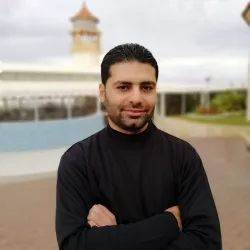
“Come on! Film and post it, so Our Father Trump can see,” shouted a man in his sixties, standing ankle-deep in cold water at the entrance of his tent in Zeitoun, a battered neighborhood in Gaza City.
I met Hassan Al-Sheikh in a makeshift camp sheltering families displaced by the ongoing war on the Gaza Strip—a war that has entered its third year with no end in sight. The night before, heavy rain had flooded the camp, turning the ground into a swamp and driving many residents out of their shelters.
Al-Sheikh has lived in one of these canvas tents since an Israeli airstrike took the lives of his wife, children, and extended family. The tent, he said, offers no protection, “These tents do nothing. They don’t keep out the winter rain or the cold. And in summer, they trap the heat like an oven.”
Our Father Trump
Within hours of the downpour, Hassan Al-Sheikh’s tent was flooded, along with those of his neighbors. The foam mattresses were soaked. So were the few belongings they had: firewood for cooking, a sack of flour, and the threadbare blankets that barely shield them from the chill.
Al-Sheikh is furious that this is still his reality nearly two months after the Trump ceasefire plan was formally approved by the UN Security Council. “They said on the news that the Security Council approved Trump’s plan,” he said. “I understood that he wants to take over Gaza and run it for two years. I don’t know why he wants it—but what I do know is that we need someone to rescue us and rebuild our homes.”
The Trump plan, first implemented in October, called for an immediate ceasefire and a structured exchange of detainees between resistance groups—chiefly Hamas—and the Israeli military. It also mandated a phased Israeli withdrawal, and the opening of key crossings to allow urgently needed humanitarian aid into the Strip.
But its later stages carry more complex political baggage: the disarmament of resistance factions, deployment of international forces along Gaza’s borders, and the establishment of a new Palestinian governing authority to oversee postwar reconstruction.
For displaced Gazans like Al-Sheikh, these developments raise more questions than answers. “Every day, I hear talk about dividing the Strip into two zones,” he said. “But no one explains what that means for us.”
Under the terms of the proposed plan, the Gaza Strip would be effectively divided into two distinct zones. The area designated as “New Gaza”—located east of what is known as the Yellow Line, marking the zone of direct Israeli military control, would be the focus of future reconstruction efforts. But that promise comes with heavy conditions.
Before any permanent housing or infrastructure is built, the plan calls for the removal of underground tunnels, the deployment of international security forces, and the transformation of the area into a weapons-free zone. Only then, international mediators say, will large-scale rebuilding begin.
The second area, referred to in the plan as “Old Gaza”, lies west of the Yellow Line. It has borne the brunt of the destruction. Entire neighborhoods have been flattened. More than two million Palestinians now live among the ruins, many in tents hastily erected between bombed-out buildings. It remains unclear when, or even if, reconstruction will begin in this part of the Strip.
“It doesn’t matter who wants to govern Gaza,” said Hassan, “what matters is who will bring life back to us.” For him, that means anyone willing to rebuild homes and restore services: electricity, clean water, roads, hospitals, and schools. “If Trump is the one taking responsibility for Gaza, then, for now, he is our father.”
His words aren’t naïve. They are spoken with deliberate irony.
“The world abandoned us after our lives were destroyed. So if Trump is the only one watching, he should provide what we need, based on what we’ve lost,” he said.
Al-Sheikh’s suffering is not only physical—though that, too, is severe. He lives with a slipped disc and high blood pressure, conditions made worse by the cold, damp floor of his tent and the absence of medical care. But his remarks cut deeper: a sharp indictment of the political paralysis and strategic neglect that have left him and millions of others not only displaced, but discarded.
Ignoring the rightful land owners
Thirty-nine-year-old Abdullah Al-Dayya shares Hassan’s frustration. For him, too, reconstruction and a return to normal life are the most basic and urgent needs. His home lies east of the Yellow Line; a zone now under the control of the Israeli army.
“My house was destroyed like thousands of others,” he told Al Manassa. “I saw it from a distance, but couldn’t get near. The area is exposed, dangerous, and within range of army positions because of all the destruction.”
Al-Dayya also followed news of the American plan adopted by the Security Council. But the headlines bear little resemblance to reality.
“The whole world talks about ceasefire, but every day there are explosions, shelling, and demolitions. People are still being killed. We see the strikes behind the Yellow Line, targeting homes and neighborhoods. Isn't the war supposed to be over?”
He’s also heard of US plans to build temporary housing compounds, stacked container-like units, on the eastern side of the Strip. But he questions how such plans can go forward without consulting the people who actually live there.
“They talk about rebuilding,” he said, “but no one has asked us. What about our land, our homes? Are we not even part of the conversation?”
Al-Dayya supports the ceasefire and prisoner exchange at the heart of the American plan. But the unfolding details, he warns, risk turning Gaza into a security zone managed by foreign forces with little regard for Palestinian lives. He fears the deployment of international troops will enforce Israeli and US priorities, not peace.
“They talk about security, not schools. Disarmament, not hospitals,” he said. “Our children have no education. The sick have no medicine. No one is asking what we need.”
Women suffer twice as much
Since the war began, Palestinian women have borne a disproportionate share of its toll; fleeing repeatedly, often with children in tow, seeking shelter in tents or overcrowded classrooms.
That’s the reality for 35-year-old Samia Yassin, a mother of seven, whose home east of the Yellow Line was destroyed early in the war. Displaced more than a dozen times, she now lives in a worn-out tent, washing clothes by hand and cooking over scraps of wood and plastic left behind by the bombardment—even after the ceasefire was announced.
“Before the war, I had a house, a washing machine, a gas stove, and my own bedroom,” she told Al Manassa. “Now I have nothing.”
What she longs for most is housing that restores some dignity and meets her needs as a woman. “We’ve endured humiliation and double the pressure,” she said. “We lost our femininity. We lost everything. And worst of all, there’s still no solution on the horizon.”
Samia Yassin follows the news, she knows that 13 countries voted in favor of the US-backed plan at the Security Council, with China and Russia abstaining. She’s seen the mixed responses from Arab states, international actors, and even Palestinian reactions. But none of it matters to her.
“All this political talk,” the mother of seven said, “doesn’t change anything for me. What matters is whether I can go home, whether my children will have food, water, and a place to sleep."
“The plans they are talking about will take years to implement. Am I supposed to live in a tent for five or 10 years? Are my children supposed to grow up in a tent? Every day we die a thousand times, my children and I, from illness and the lack of education and proper food,” she said.
Like thousands of other Gazans, Samia Yassin feels she has no choice but to endure the harsh conditions imposed by war and shaped by international politics. Still, her demands are modest: she wants a temporary shelter that offers basic dignity.
“Even just a prefab caravan,” she says—something with a door to close, a roof that keeps out the rain, and space for her children to sleep safely.
She sees this as the bare minimum needed during what could be years of waiting—an interim period between the slow, contested rollout of the Security Council resolution and the distant prospect of real reconstruction. A home remains the goal. But for now, she would settle for privacy, stability, and the restoration of some semblance of ordinary life.