
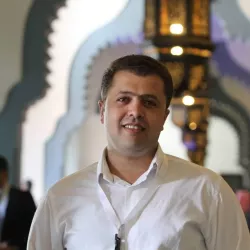
Basma Moussa: A Baha'i woman against all forms of oppression
Israeli warplanes “shone brighter than the stars” above the heads of children among tens of thousands of the Suez Canal Zone residents who had to flee their hometowns under bombardment, seeking refuge in Cairo or nearby Delta governorates. Among them was a nine-year-old girl from Port Fouad named Basema Gamal Moussa.
Basema, later known as Basma, was born on Oct. 19, 1958 to Baha'i parents who lived with their six children in a house owned by a Greek family who rented out the first floor to a Nubian household. Then came the war, and everyone left.
The Moussa family moved from Port Fouad to Kafr El-Zayat, where they spent the War of Attrition and the years that followed. A new house, different streets, another school; an imposed migration dictated by an enemy that did not distinguish one Egyptian from another.
When the war ended, Basma, her parents, and her five siblings returned home to Port Fouad. She finished high school in a Port Said school, and then left again—this time by choice—to study dentistry at Cairo University.
Early scars
Homelands offer identity, but they also leave scars. Her first scar came in her hometown of Port Said before the 1967 war. On her first day of school, come the religion lesson, the teacher asked Christian pupils to go to the courtyard for their class. They left. The Muslim students remained. Basma hesitated, not knowing where to go, “I’ve memorized Al-Fatiha and short surahs from the Quran, but I’m Baha'i. Where do I go?”
Basma’s sister, Ola, recalls the story in an interview with Al Manassa. “The teacher snapped at her and told her this was nonsense, saying there was no such thing. She punished her by making her stand next to the blackboard and asked her to bring a parent to school the following day.”
“That was the first time she experienced discrimination,” Ola adds.
Basma was fortunate the school principal had a Baha'i friend; she was understanding. So when Basma’s father walked in, the reprimands stopped. Like her siblings and almost the entire Baha'i community, she opted to study Islamic religion.
But the scars multiplied.
The second scar came when she graduated in 1981 with grades high enough to join academia, she was appointed a teaching assistant the following year, as academic rules require. But the process that should have unfolded smoothly did not.
On the day she was appointed, a young dentist named Alaa Al-Aswany was hired as well. They spent an academic year together, during which he would later recount, in a 2009 column in Al-Shorouk, the discrimination Basma endured: “Several professors declared what they considered a holy war against her. She was deliberately failed in every exam she took, despite her excellence, which everyone acknowledged.”
Mocking her faith, deriding her, and accusing her of apostasy became routine. But she “fought the war bravely,” he wrote. She submitted hundreds of complaints to state officials “until she finally passed the doctoral exam thanks to the intervention of the university president himself, and the support of fair-minded professors such as Dr. Sherif El-Mofty and Dr. Hani Amin.”
Until Al-Azhar intervened.
Professors opposing the appointment of a Baha'i to an academic post secured a fatwa from Al-Azhar declaring Baha'is apostates. In January 1986, Aqidati, a religious newspaper spinning from the state-owned Akhbar Al-Youm, published a statement from Al-Azhar’s Islamic Research Academy condemning the “Baha'i call,” citing historical accounts of Baha'is facing “killing and persecution” at the hands of Muslims.
Basma recounts the trauma in the documentary titled “Identity Crisis” by director Ahmed Ezzat. “They went to Al-Azhar and got a paper saying I was an apostate,” she said. “I was shocked that a religious institution like Al-Azhar would issue a certificate declaring someone apostate without even asking them.”
She added, “Apostasy is when a Muslim abandons Islam. But as a Baha'i, I believe in all the Abrahamic religions, in Prophet Muhammad, and that there is no God but Allah and Muhammad is His Messenger.”
Her master’s degree was delayed seven years, and her doctorate nine. She did not attain the rank of professor until 2012, almost 30 years after graduating. Typically, the process requires five years as an associate professor or ten years after receiving the required qualification.
Suspended rights
In “Identity Crisis”, director Ahmed Ezzat tried to document the deepest scar: the Higher Administrative Court ruling of Dec. 16, 2006 that denied Baha'is the right to obtain identity documents.
The crisis had begun six years earlier, when the Ministry of Interior stopped issuing paper ID cards and replaced them with computerized national ID cards. The Civil Status Authority stopped issuing or renewing official documents for Egyptian Baha'is unless they agreed to list their religion as one of the three officially recognized faiths: Islam, Christianity, or Judaism, which were the only available options listed in the computerized data fields.
The ministry presented Egyptian Baha'i citizens with two options: lie about their religion, or be denied identity documents altogether; a bureaucratic erasure that froze their civic rights, excluded them from society, denied their existence as recognized persons, and suspended their rights and access to government services.
Because civic rights cannot be put on hold, Baha'is turned to the State Council. In April 2006, the Administrative Court ruled in their favor, granting them the right to record their actual religion. But the Ministry of Interior appealed. In December that same year, the Higher Administrative Court overturned the ruling—again suspending the civic rights of Baha'is and adding, for good measure, that adherents of the Baha'i faith were “apostates.”
The repetition of wounds, reaching the point of the state bargaining citizenship for belief, drove Basma to the Faculty of Economics and Political Science, where she earned a diploma in Civil Society and Human Rights in September 2005.
Her life in those years was split among work, her studies, and the courts. She was present when the ruling denying recognition was issued, as she had been at every hearing. She spoke to activists and journalists, as she always did, about civic rights. In the film, she simply asks “Why can’t I have an ID card?”
At conferences and public forums, she would ask why she could not record her marriage on her ID.
In 2006, she joined Misriyoun Against Religious Discrimination (MARED), where she earned the respect and affection of everyone. “She was unfailingly polite, respectful, and calm, with a deep belief in equality among people,” said Mounir Megahed, a founding member.
“She dedicated her life to defending the Baha'i cause,” he told Al Manassa, “She could always find a middle ground. For example, we demanded that the religion field be removed from ID cards altogether, but when it became clear the state wouldn’t do that, she was willing to accept alternatives—like listing ‘Other,’ or a dash.”
Baha'is returned to the State Council in January 2007 to demand the right to obtain official documents without being forced to register a religion they did not believe in. A year later, in January 2008, the Administrative Court ruled that the Civil Status Authority must issue such documents, leaving the religion field blank or replacing it with a dash.
But the state still refused to implement the ruling. She could not issue a bank card or withdraw her own money. Her sister was barred from applying for her son for a youth housing scheme run by the state, she told Al-Masry Al-Youm in an August 2008 interview.
The suspension continued even after the ministry announced it would not appeal the ruling—claiming it was waiting for decisions on other lawsuits filed by Islamist lawyers. It only ended when, on April 14, 2009, the interior minister finally issued a directive allowing a dash in place of the religion field.
Against all oppression
Basma Moussa spoke at numerous conferences and forums organized by civil society and human rights groups. She published articles in defending women’s and children’s rights, education, environmental protection, and the values of tolerance and peace.
Despite her activism, she stayed clear of politics. She never joined a party or a political movement, and in every interview she clarified that her faith prohibited political participation.
Her life branched in many directions, but it always converged on a single purpose: ending religious discrimination.
“In our faith, politics is forbidden, as is joining parties, because the Baha'i faith believes in the unity of humanity,” she explained in her Al-Masry Al-Youm interview, “If we join parties, that unity collapses.” Still, Bassma was deeply invested in the struggles of the oppressed and of minorities.
After the January 2011, the post-revolution constitution—drafted largely by Islamists—restricted freedom of worship and the construction of houses of worship to the “Abrahamic religions.” When the new regime ousted the Islamists in 2013, Bahaaís hoped their civic rights would finally be restored. They formed a delegation that included Basma to meet Amr Moussa, chair of the 50-member committee drafting the new constitution. She called for a law criminalizing discrimination against minorities and for an independent authority to monitor discrimination and persecution.
But the Islamists’ removal did not improve the legal standing of Baha'is or others. Freedom of belief in the constitution remained limited.
Discrimination post mortem
Basma’s life took many turns, yet they always led her back to the same goal: ending religious discrimination and ensuring civic rights for all.
But one last scar awaited her after her death on Saturday, Nov. 29, 2025.
According to a photograph obtained by Al Manassa, Basma was buried in a narrow space carved between two graves in the Baha'is cemetery in Al-Basatin—the only burial site allocated to Baha'is since the 1930s. Its space is nearly exhausted, and transporting bodies from across the country is arduous. Still, Egypt refuses to allocate new land for Baha'is burials.
The enemy that drove her from her hometown did not distinguish among Egyptians. But Egypt did. Basma paid every cost, yet when the time came to grant rights, the lines of division appeared. Through it all, she stayed calm—even when confronting, with quiet courage, the injustice of those closest to her: her fellow citizens.