
Interview| Egypt’s former envoy to Tehran: “Iran retains the right to strike US bases in the Gulf”
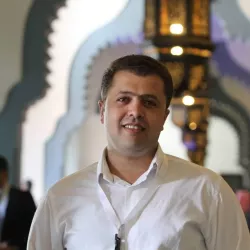
Ambassador Khalid Emara, Egypt’s assistant foreign minister and its former and longest-serving head of the Interests Section in Tehran, offers a reading of the escalating conflict between USA, Israel and Iran shaped by years on the ground in Tehran.
Having lived there from 2011 to 2016, he draws a parallel between Iran after the 1979 revolution and Egypt under Gamal Abdel Nasser: both backed national liberation movements, placed Palestine at the center of their politics and built alliances beyond the region.
By that measure, he argues, the enmity directed at Nasser’s Egypt in the 1950s and 1960s helps explain the sustained US-Israeli hostility toward Iran from the late 1970s to the present.
At the same time, the Egyptian diplomat links the delay in normalizing Cairo–Tehran relations and restoring ambassador-level representation to the region’s cascading crises.
We spoke to Emara at Al Manassa on March 15, when he responded at length to questions about the war, regional diplomacy and Iran’s internal dynamics.
Who is blocking normalization?
Emara rejects the idea that Egypt–Iran ties and full normalization between the two countries are constrained by a simple “US veto” or “Gulf veto”. In practice, he says, relations already function at a high level.
“Egypt’s Interests Section in Tehran operates as an embassy in all but name,” he said. “They treat it as a full embassy on the ground.”
The same applies in Cairo, where the Iranian mission enjoys considerable access. Its head, Ambassador Ferdowsi-Pour, appears regularly in Egyptian media and public life.
Rather than external obstruction, Emara points to repeated regional crises. “Each time the two countries draw closer, an emergency erupts that complicates decision-making,” he said. “More than once we reached the point of announcing a restoration of relations.”
The term “interests section”, he adds, understates the reality. It emerged from efforts in the early 1990s to restore ties under diplomatic arrangements governed by the Vienna Conventions.
Diplomatic law governs relations when ties are severed and missions withdrawn, allowing a third country to safeguard interests. This practice, recognized by the 1961 and 1963 Vienna Conventions, fills the vacuum left by the absence of diplomatic representation.
Egyptian public sympathy for Iran
In late February, USA and Israel launched their assault on Iran—a chain of assassinations that targeted Supreme Leader Ali Khamenei and has continued since. Tehran responded with sweeping strikes that reached Tel Aviv and US bases and embassies across the Gulf and the wider region. As the US-Israeli bombardment continued, Iran closed the Strait of Hormuz and attacked several vessels that attempted to pass through it.
Emara explains what appears to be popular Egyptian support for Iran in the ongoing war this way: “Egyptians, by instinct, see threats and invasions as coming from the east. That eastern flank is now fully exposed. Palestine is in an extremely dire state; Lebanon and Syria—there is no end to what can be said—and Iraq as well. Iran is the only power left on Egypt’s eastern horizon. It stands, as we say, as a bulwark against a project of domination—a new imperial project led by the US, deploying every available instrument, with Israel as a functional arm in the region.”
He adds that many Egyptians view Iran as a major state resisting US-Israeli expansionism. “Talk of a ‘Greater Israel’ has become routine. The US president goes on record saying Israel is a small state that must expand, must grow. They even present maps at the United Nations. Egyptians are politically aware; they can read the scene clearly. I imagine the political leadership in Egypt shares deep concerns about a vacuum on the eastern front.”
A region unsettled since Iraq
Asked whether Egypt’s position might shift from neutrality, Emara suggests that official language—referring to “miscalculations by all parties”—leaves room for change.
“There are clear American miscalculations, and perhaps Israeli ones as well,” he said, while also pointing to internal Iranian missteps, including delayed responses to economic and political grievances dating back to the 2009 Green Movement.
“Lately there were the bazaar’s demands—what we might call the middle class—as well as those of students and young people. These should have been addressed early.”
Large protests broke out across several Iranian cities in January over rising inflation and deteriorating economic conditions, before quickly taking on a political character.
For Egypt, he adds, regional stability is paramount, and Cairo is working to contain the conflict. “The region has been in turmoil for a very long time—from the invasion of Iraq to the present,” he said. “That weighs on development and the ambition to build a modern state.”
Targets, and the Gulf in the crosshairs
Emara argues that Iran’s strikes on US bases in the Gulf align with international law under the right to self-defense. “Iran has been explicit, through its foreign minister, that it is acting in self-defense—regardless of where the threat originates.”
From the opening salvo of the US-Israeli assault, Iran targeted Israeli cities and US military installations across the region, particularly in Gulf states. This raises a fraught question: To what extent can a state under attack strike at the zones of influence of its adversary? Emara places part of the responsibility on Gulf governments, which he says became parties to the confrontation “by hosting bases from which Iran is being targeted.”
Whatever official or popular positions may be, he added, “when a missile is launched toward Tehran, Mashhad or Isfahan from these bases—within states that do not necessarily control what happens inside them—we are dealing with a highly complex issue, layered on many fronts.”
He stresses that Iran is acting “under the umbrella of international law and the UN Charter,” having been subjected to a premeditated assault by the US and Israel, “backed by a network of military bases.” On that basis, he says, Tehran is entitled to defend itself. He faults Gulf states for accepting foreign bases on their soil: “You don’t place yourself in harm’s way and then claim you’ve been harmed.”
He goes further: “Was it wise—or even natural—for the Gulf to be in a state of hostility with Iran? Why? It is a neighboring country, and ultimately a Muslim one. There was an effort to turn the page on exporting the revolution in the early years of the Islamic Republic.”
On calls to dismantle US bases in the Gulf, after those same bases exposed host countries to harm, Emara said Tehran is unambiguous. “Iran openly asks them to do so. It is defending itself by striking these bases, as well as concentrations of US troops and intelligence assets—American or Israeli—present in those locations. At the same time, it calls on Gulf states to reconsider their stance toward these bases, which it sees as a primary driver of regional instability.”
For Egypt, the stakes are immediate: “Egypt stands in clear solidarity with Gulf states facing economic disruption and strain on daily life,” he said. “Millions of Egyptians live and work there, so any escalation feeds directly back into our own stability.”
A plan to break the region
Referring to a phone call between President Abdel Fattah El-Sisi and his Iranian counterpart Masoud Pezeshkian—during which the latter spoke of a US-Israeli plan targeting major Muslim countries in the region, naming Egypt, Turkey, Saudi Arabia and Iran—Emara said Cairo reads the situation with caution, closely watching decision-making circles in Washington and Tel Aviv.
He points to rhetoric that preceded the war. “There was that well-known statement by Mike Huckabee, the US ambassador to Israel, who said Israel has a biblical right to expand across the region and framed the war as part of Armageddon. The US defense secretary repeated similar language, calling it a crusade. What more needs to be said?”
Emara says Egypt’s leadership is acutely aware of these dangers. “We are not waiting for Pezeshkian to tell us anything. There is already deep anticipation—and fear—across the region’s peoples, the indigenous populations that have lived here for thousands of years, including the Palestinian people. We have witnessed wars of annihilation, the wars on Lebanon, what happened in Syria… The Syrian army collapsed in three or four days, with all its weapons and ammunition. Before that, Iraq. And when Gaddafi handed over all his cards, they finished him off.”
Imperial overstretch
Emara labels the current confrontation the “Hormuz crisis,” drawing a parallel to the Suez Crisis in its early stages and underlying aims. On Oct. 29, 1956, Israeli forces invaded areas east of the Suez Canal, the Sinai desert and then Gaza, providing Britain and France with a pretext to join the war on Oct. 31—what became known as the Tripartite Aggression.
He expects the US will not emerge from the Strait of Hormuz crisis as it entered it, likening its trajectory to Britain’s after Suez: “Britain went into Suez as a global empire on which the sun never set—and came out into the fog.”
“History runs in cycles, and its lessons are many,” he added, arguing that the US faces what can be described as imperial overstretch—an expansive global reach it can no longer control, now turning against it.
Inside Iran
Returning to the war’s impact on Iran’s domestic front, Emara—head of Egypt’s Interests Section in Tehran—argues that the strength of the Iranian system flows from the strength of the state itself. Iran, he says, possesses the components of “comprehensive power” across multiple domains.
“In education, literacy is widespread and standards are high. In health care, all 95 million citizens are covered by comprehensive services—from medication to treatment, hospitals and surgeries. Scientific research is highly advanced, in applied and future sciences—from computing to algorithmic systems, information technology and communications. There is a large-scale space program, alongside missile capabilities, drone development and the nuclear program.”
He sees the political system as part of that strength: “It is an institutional system that operates in a modern way, with a degree of balance between institutions—checks and balances—alongside collective work. Children learn from an early age how to work as a group, in a way reminiscent of Asian models. Women play a significant role across all fields.”
On the economic dimension, he continues: “This is a society that has lived under sanctions for 47 years, with zero domestic debt and zero external debt—no constraints. It has assets frozen abroad worth hundreds of billions, scattered across the world. It has food self-sufficiency and major industrial capacities—automotive manufacturing, agricultural equipment, public transport. Even in Egypt, after the wars, the first buses were Iranian Mercedes buses, produced at the Mercedes plant in Iran.”
He emphasizes that protests are an integral feature of the system since the Islamic Revolution. “Iranians demonstrate all the time. During the Green Movement they protested; during the protests following Mahsa Amini’s death over the hijab issue, they protested. Demonstrations are a core part of political life there.”
Addressing Donald Trump’s claim that more than 30,000 people were killed in recent protests in Iran, Emara dismisses it as false. “The US president uses the term ‘fake news,’ and I will use it as well. If that were true, we would have seen urban warfare in Iranian cities—every victim has a family, a community.”
Emara does not deny confrontations with protesters. “Of course there were clashes. But these figures are fantastical—numbers of that scale would have brought the system down from within.” He suggests that initially peaceful bazaar protests were later infiltrated by groups from outside Iran.
Intelligence breaches
Emara’s remarks lead to questions about the scale of intelligence penetration that enabled the assassination of top officials, including the Supreme Leader. He downplays the shock: “Every country is penetrated—there is no country that isn’t. We’ve seen Russian generals killed by drones, and that’s Ukraine, not the US. Such breaches are part of the landscape.”
He believes the breaches are ongoing but says Iran “learns from its mistakes.” He points to Hezbollah adjusting its use of technology after past errors. “The same applies in Iran. This is a struggle over how to protect yourself amid rapid technological advances and artificial intelligence.”
At the same time, he acknowledges the technological edge of the US and Israel. “When Iran uses Baidu—the Chinese system—the situation is better than before.”
“Penetration is a core feature of modern warfare,” he said, referring to hybrid and cyber operations that use advanced technology to track individuals, identify targets and carry out precision strikes.
Leadership under fire
On the targeting of senior officials, Emara notes that Iranian leadership does not operate from underground bunkers “in the European or American sense.”
“Ali Khamenei was in an ordinary building—like the one we are sitting in—and was targeted at his home. Photos of his residence show how simple it is. He was asked to leave and refused. He said: Does the Iranian people have another place to go? Everyone will stay where they are. There is a sense of trust in God.”
Emara links this posture in part to doctrine and the centrality of martyrdom in Shiite thought—“a longing for martyrdom in emulation of Hussein and Ali.”
Despite the successful targeting of top-tier figures, he argues that what matters is a state’s ability to absorb such losses. “The key is to have mechanisms to deal with the loss of first- and second-tier ranks and to replace them smoothly.”
A war decades in the making
Emara argues that the current war reflects longstanding US ambitions for dominance, pursued through a range of military and political tools, with Israel accelerating the confrontation. In his view, the roots of the conflict stretch back nearly five decades.
As for the war’s stated aims—toppling Iran’s political system and dismantling its nuclear and missile programs—he says they remain unmet. “There was a certain arrogance of power,” he added.
“The system today is at its strongest—it has shed its skin and remains cohesive. The nuclear program employs more than 33,000 scientists and specialists. Can such a program be dismantled with a few missiles? All its personnel are Iranian, trained in Iranian universities, among the leading experts in the field. And the 60% enriched uranium they want to seize—why didn’t special forces go in and take it, sell it, turn it into a lucrative deal? It didn’t happen.”
On the missile program, he says, “the missiles speak for themselves.” As for Iran’s regional allies, he points to Hezbollah’s recent performance as evidence of enduring capacity. “Over the past few days, its capabilities have been striking—massive missile capacity and advanced fighting units on Lebanon’s southern front, even as some assumed the group was finished.”
When will the war end?
On back-channel diplomacy and efforts to contain the escalation, Emara points to an active Egyptian push. “Within the Egyptian diplomatic establishment, containing the war is the primary concern,” he said.
He frames this as part of a broader effort to protect national interests. “We have a vital interest in restoring stability to Bab El-Mandeb, the Suez Canal and Hormuz,” he said, citing ongoing regional outreach by Egypt’s foreign minister and high-level contacts aimed at de-escalation.
Emara suggests energy markets will ultimately drive a resolution. The question, he adds, is whether the US and its allies can reopen the Strait of Hormuz by force.
Several countries have resisted calls to deploy naval forces to reopen the waterway after Iran announced its closure on 2 March. “No one can withstand prolonged spikes in energy prices,” he said, arguing that affected states will be pushed to intervene.
Gulf countries, he added, also have strong incentives to de-escalate. “It is not in their interest for the war to continue—the strait carries not only oil, but food, water and trade.”
Emara argues that Iran is unlikely to accept an inconclusive end to the conflict. “It will not accept an open-ended outcome that allows the war to resume months later,” he said, suggesting Tehran is seeking a clearer political resolution.
In his account, Iran wants the war to conclude with a US acknowledgment of a “strategic mistake”. A short conflict, he adds, is not necessarily in Tehran’s interest, given its experience with prolonged wars.
As for US statements signalling tolerance for a drawn-out confrontation, he dismisses them as “rhetoric—part of a pattern of fiery statements.”